The Vestige at the Doorstep: Iron and Steam Memory
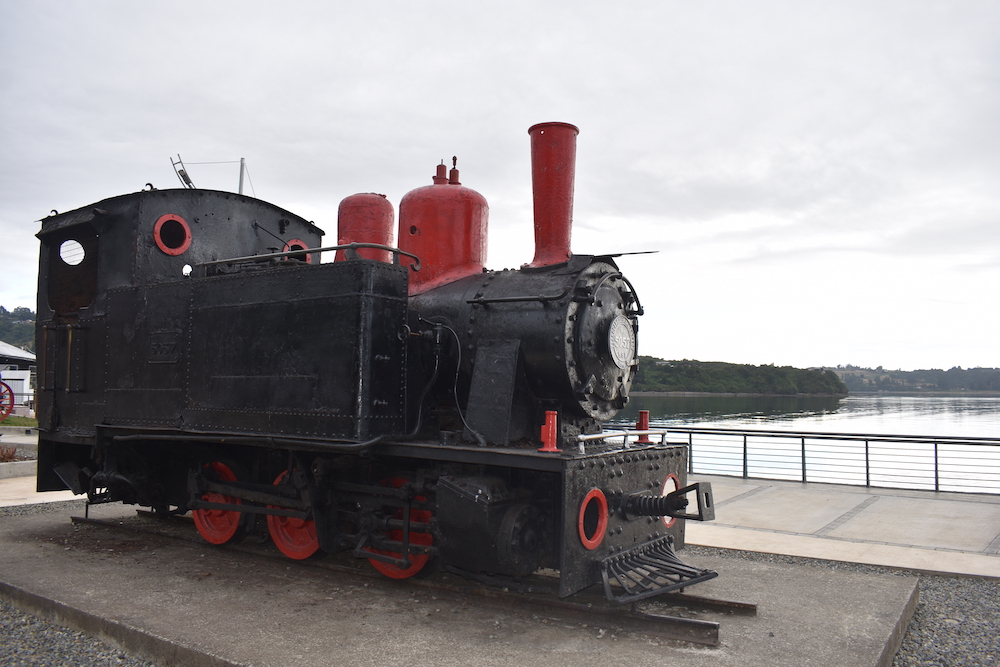
In El Tren Plaza, right along Pedro Montt Street and steps from our entrance on the waterfront, rests the silent Henschel Locomotive No. 5057. With its unique narrow gauge of just 60 centimeters, exposed connecting rods, and steel body rusted by sea breeze, this small German engine is no mere urban ornament; it is the physical witness of a Chiloé that once defied its own geography.
Between 1909 and 1912, the construction of the railway connected the ports of Ancud and Castro across nearly 97 kilometers of rugged terrain. These were the years of timber and industrial prosperity, when steam whistles echoed through the cold rainforest. Poetically dubbed by Nobel laureate Pablo Neruda as “the giant slug” or “the rainy train,” it transported thousands of tons of native tepa timber, sacks of potatoes, and passengers sharing stories at a leisurely pace of 30 kilometers per hour.
The Geological Milestone: When the Earth Shook and the Sea Reclaimed Its Domain
On the afternoon of Sunday, May 22, 1960, at 3:10 PM, time came to a standstill in southern Chile. The most devastating cataclysm recorded in modern seismology—measuring 9.5 on the Richter scale—shook the foundations of the archipelago for over seven continuous minutes. The force of the seismic movement not only collapsed wooden warehouses and mansions; it subsided the island shelf by one to two meters, permanently altering the coastline and tidal regimes.
Shortly after the quake, the sea receded from the bay only to return as a massive tsunami. The impact of giant waves and subsequent fires devastated port infrastructure and completely submerged Castro’s old railway station. Tracks were twisted like wire, bridges collapsed, and cuttings caved in under landslides. The tide permanently silenced the island railway, returning absolute control of Chilota routes to the inner sea and channels.
The Contemporary Refuge: Where History Finds Rest
Six decades later, Castro has flourished upon its resilient memory. Estación Hostel was born along this very historical shoreline, reviving the concept of a "station" as an essential starting point for cultural travelers seeking to decipher the deep layers of the territory.
Upon returning to our space after a day exploring fjords, wooden churches, or coastal wetlands, travelers discover a subtle dialogue between history and contemporary design. The understated elegance of our Fjord Blue interiors evokes the depth of tides that reshaped the island, while the warmth of Live Rust pays homage to the patina of time etched into the steel of the old locomotive. Here, a community of nomads and explorers gathers to share stories around a refuge crafted for restful sleep, contemplation, and authenticity.
Continue Exploring the Logbook

History is not observed in a distant museum; it is inhabited from your window.
Begin your own journey through Chiloé's living heritage.
Book Your Station